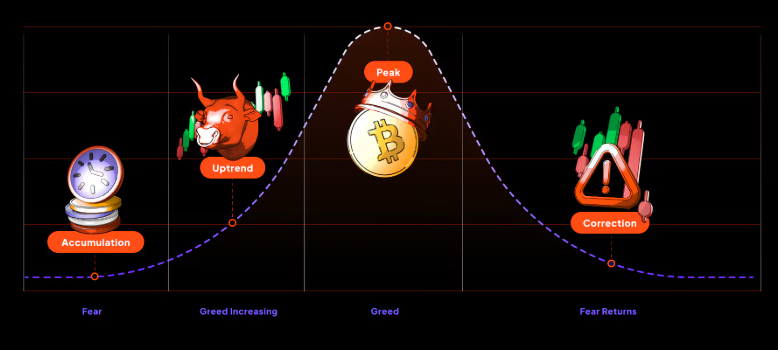

Crypto market cycles unfold through repeatable phases driven by liquidity, sentiment, and structural incentives. Accumulation quietly builds exposure as risk appetite contracts and on-chain activity finds a floor. An ensuing uptrend accelerates via leverage and momentum, then distribution signals waning upside and asset rotation. Downturns tighten funding, compress liquidity, and trigger capitulation. Each stage is shaped by funding conditions, news flow, and network effects, with cross-asset signals and liquidity metrics offering empirical guardrails for regime shifts and position sizing—a frontier that invites further examination.
What Is the Crypto Cycle?
The framework emphasizes external drivers, investor behavior, and systematic feedback, yielding a defensible, empirically grounded model of cyclic continuity and freedom-oriented market dynamics.
Phases of the Crypto Cycle: Accumulation, Uptrend, Distribution, Downturn
Accumulation, uptrend, distribution, and downturn constitute the four-cycle framework through which crypto markets organize price and liquidity dynamics. This framework delineates phase-specific behavior: accumulation quietly builds positions; uptrends extend rising momentum and leverage exposure; distribution signals waning upside and asset rotation; downturn reprices risk, liquidity tightens, and capitulation occurs. Bears market pressure persists; altcoins rally temporarily in speculative bursts, then reset fundamentals.
What Drives Each Phase: Funding, News, and Network Effects
Funding, news flow, and network effects jointly shape each phase of the crypto cycle by translating capital allocation, information dissemination, and adoption dynamics into observable price and liquidity patterns; funding conditions constrain leverage and margin expansion during uptrends, while tightening during downturns.
Empirically grounded, the analysis isolates funding dynamics and network effects as core drivers of phase transitions, quantifying their impact on volatility and liquidity.
Reading the Cycle and Next Moves: Signals, Risks, and Tactics
Signals and risks key to the cycle are synthesized from cross-asset indicators, liquidity metrics, and macro-linked funding conditions to produce a parsimonious framework for anticipating regime shifts.
The analysis quantifies volatility indicators, maps regime transitions, and hardens risk management practices. It emphasizes objective thresholds, repeatable signals, and disciplined position sizing, enabling freedom-oriented decision makers to navigate cycles with calibrated expectations.
See also: How Artificial Intelligence Helps Detect Cryptocurrency Fraud
Conclusion
Crypto cycles unfold through repeatable, data-driven phases: quiet accumulation, momentum-led uptrends, distribution-driven waning upside, and tight-liquidity downturns. Each phase is sculpted by funding conditions, news flow, and network effects, with cross-asset signals and liquidity metrics guiding risk signals and regime shifts. By tracking trajectory, velocity, and curvature of capital flows, one can quantify phase duration, peak intensities, and transition triggers. In a distant future, a cobwebbed chart whispers that cycles persist, like an ancient compass in a neon city.